


Today we are going to talk about environmental education activities for secondary school, that is, ESO and Bachillerato.
Environmental education, although supposedly included in educational curricula both directly and across subjects, is often treated in a highly theoretical manner and, in some cases, is shoehorned in. Furthermore, its presence is merely symbolic in some subjects.
At Explora Natura, we like to think of environmental education as a necessary complement to formal education. For this reason, we approach our activities by including in their planning and execution aspects such as the basic skills to be addressed and the personal and social skills (increasingly important as demonstrated in the workplace) that we aim to develop.
So, let's get started with the environmental education activities for secondary school students. They can be done with both middle and high school students. What's more, they can be adapted to the level of the participants.

Environmental education activities for secondary school: Can plants fly?
Flight occurs when the design of living beings or man-made structures is able to harness the properties of air to rise. Besides flight, air has many other uses, which we will discover as we complete this activity.
The objectives we want to achieve with this activity are:
- Investigate the forms and structures presented by living and artificial forms capable of flight.
- Use problem-solving skills to design a flying device.
- Explain the ways in which the properties of air can be applied to the principles of flying devices.
- Understanding how nature adapts the shape of plants to the characteristics of the air to allow them to propagate their seeds.
- Design a device that allows plants to disperse their seeds.
In order to carry out this activity, it is necessary that the students first know the physical properties of air.
Basic skills that will be worked on.
- Linguistic communication
- Mathematics and basic skills in science and technology
- Learning to learn
- Sense of initiative and entrepreneurial spirit
- Social and civic
Materials needed
- Various building materials
- Different types of pods and seeds
Additional considerations
Preparation
- Identifying what makes flight possible using examples from nature.
Action
- Investigate the flight forces used in seed dispersal
- Design, build, and test a flying device that mimics seed dispersal
Consolidation
- Explain how the design of a flying device utilizes flight forces
Introduction (Provoke and engage)
The hook
One of humanity's greatest technological achievements is the invention of machines that allow us to fly. This has always been one of humankind's greatest obsessions. We have invented all sorts of things that help us stay airborne, such as airplanes, helicopters, hang gliders, parachutes, and rockets.
Which flying device do you like best and why?
Learning objectives (to share with the class)
- We will explore the design elements that allow things to fly.
- We will investigate the characteristics of seeds that fly through the air.
- We will design, build, and test a flying machine, consider how it uses the forces of flight, and reflect on the project's major problems and challenges.
methodological process
Introduction
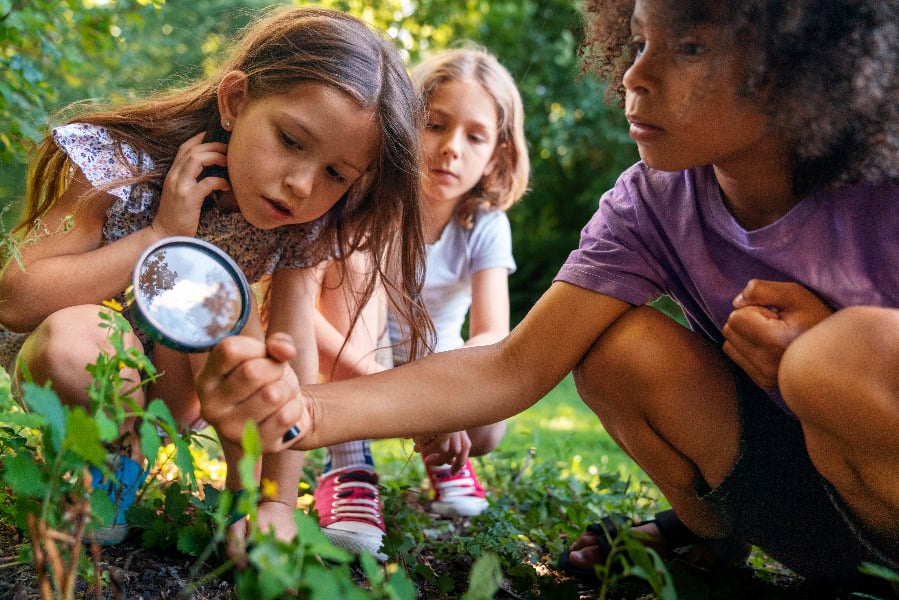
- Using examples collected from a natural area, garden, or even the schoolyard, we will examine how seeds are dispersed by the wind.
- In inventing flying devices, humans have learned valuable lessons from how bodies in nature are designed for flight. Some of the best examples are those developed by plants to disperse their seeds.
- Can students make a model of a seed dispersed by the wind?
Action (explore and explain)
- Go out into nature and observe all the things that fly: seeds, birds, insects, butterflies, dragonflies, etc. Their wings, surface, specific design, weight…
- Show specific examples of seeds that use flight to disperse. What can be observed (e.g., seed size and weight, structure, etc.)
- Why do the seeds have to move away?
- How do flight forces act on seeds?
- What is the flight method for a series of seeds?
- Make and test a flying device. It could be a kite, a paper airplane, a plastic parachute…
- How does this device utilize flight forces? What challenges did it face? How could it be improved? How do you think it performs compared to a real seed?
Consolidation (evaluation and expansion activities)
How did the pioneers in the development of aeronautical engineering design and test the first flying devices?
In this way, we conclude the environmental education activity for secondary school students, which will surely prove interesting as a project that can also be interdepartmental, since it can be carried out jointly by the science and technology department.
See you soon!




A very interesting proposal! And potentially applicable at different levels.
Thank you so much, Nora! We'll be posting more activities that can be used to learn about nature. See you soon!
Great! Initiatives like this are exactly what's needed. I'll pass it on to all the teachers I know.
All the best.
Juan C.
Thank you so much, Juan Carlos. We're so glad you found it useful. Best regards!